
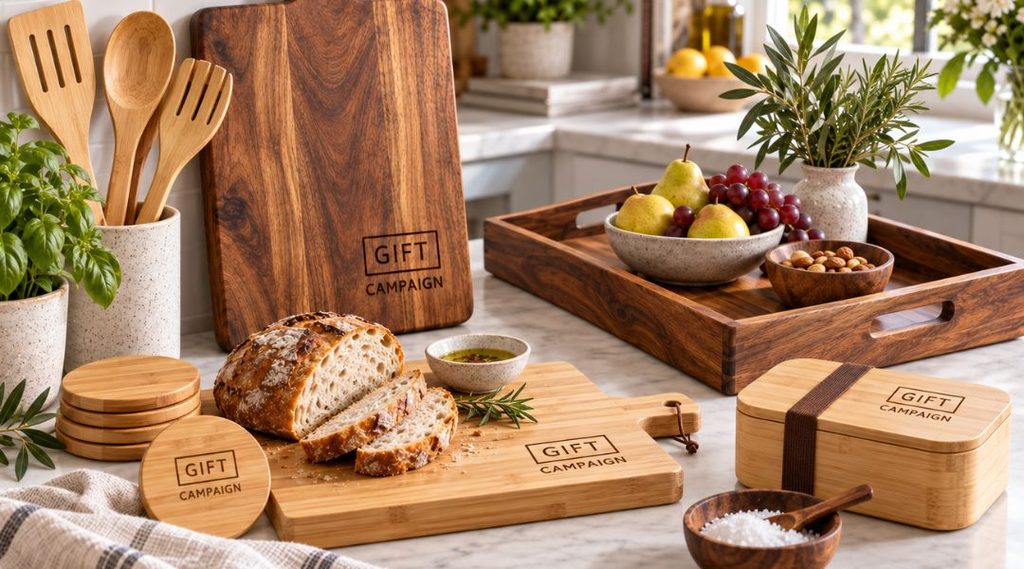
For years, bamboo has been a highly valued material in the promotional gifts sector. It can be found in pens, notebooks, bottles, keyrings, tech accessories, kitchen utensils and many other products. However, recently, we have seen another material starting to gain ground in new collections: acacia wood.
This evolution can also be seen among suppliers in the sector. Last Thursday, 10 September, Gift Campaign attended an Associations Road Show organised by FYVAR and aimfap, where the company had the opportunity to exchange ideas and insights with its suppliers. Among the different opinions shared, one particular observation about trends caught our attention: one of our suppliers explained that they are gradually incorporating more products made from acacia, particularly because of their appearance and the results that can be achieved with certain personalisation techniques.
Does this mean that acacia is going to replace bamboo? Not necessarily. Both materials offer different characteristics and can be interesting depending on the type of gift, the budget and the image a company wants to convey.
· What is acacia wood and what are its advantages?
Acacia belongs to a large group of trees and shrubs in the Fabaceae family. There are numerous species, meaning that properties such as weight, density and hardness can vary considerably between them. Many species belonging to the Acacia genus are native to Australia and various regions of Asia and the Pacific.
Its wood stands out visually for its warm tones, which can range from relatively light browns to much darker shades. It also tends to have a fairly pronounced grain, meaning that two items made from acacia wood may have slight differences in colour or grain pattern.
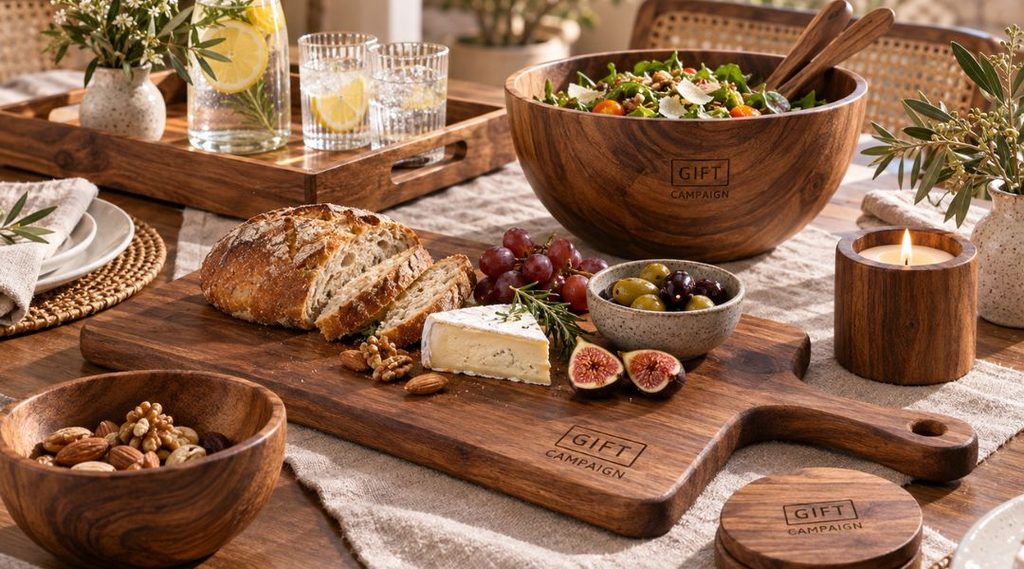
However, rather than seeing this variation as a flaw, it can become part of the product’s appeal. A personalised acacia wood chopping board, a set of coasters or a serving tray, for example, can give the impression of being more like a household item or a conventional gift than a promotional product.
Here are its main advantages:
- Its appearance. The colour and grain of the wood give the item character and can help create corporate gifts with a more premium feel.
- Long lifespan. Depending on the species used, acacia wood can have significant levels of density and hardness, although not all varieties have exactly the same properties.
- Personalisation. The combination of engraving and the wood’s natural tones can produce a particularly elegant result. This makes it an interesting choice for gifts for clients, employees or business partners when a company is looking for something more understated than typical promotional merchandise.
But, like everything good, it also has a less attractive side:
- The colour and grain are not completely uniform, so the engraving may look slightly different from one item to another.
- Acacia is generally found in larger, higher-value items, such as kitchen accessories or homeware, whereas bamboo is available across a much wider range of affordable promotional gifts.
Our catalogue already includes acacia products across the kitchen, home and lifestyle categories, including chopping boards, trays, coasters, candle holders and food-serving accessories.
· Bamboo: a classic that still has plenty to offer
Although we often refer to it as “bamboo wood”, botanically speaking, bamboo is not a tree but belongs to the Poaceae family, a group of herbaceous plants.
Its natural distribution is particularly concentrated in various tropical and subtropical regions of Asia, although bamboo species can be found in many parts of the world.
One of the reasons for its popularity is its rapid growth. Certain species can reach maturity for industrial applications in significantly less time than is typically required by many forest tree species. This has made bamboo an increasingly interesting material for a wide range of industries.
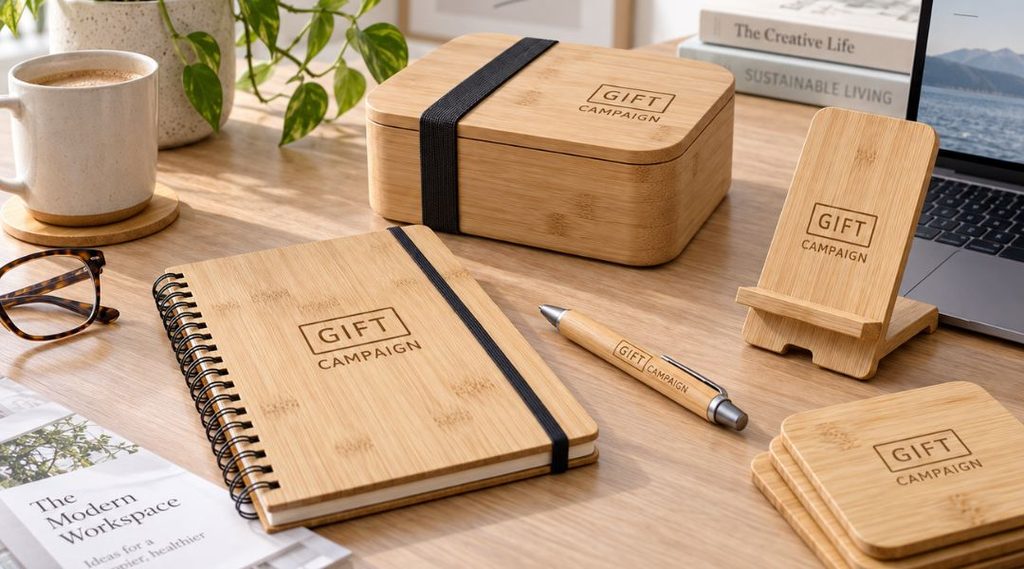
However, bamboo offers other interesting advantages in the promotional sector too. Let’s take a look:
- Versatility: Bamboo can be found in pens, keyrings, wireless charging pads, thermal bottles, bottles, kitchen utensils, toiletry bags, desk accessories and many other promotional gifts.
- Natural aesthetic: Its generally light tone makes it easy to combine with metal, glass, recycled plastic, stainless steel and other materials without making the product look overly eye-catching.
- Suitable for laser engraving: There are numerous bamboo products on which this technique allows a logo to be incorporated directly onto the surface.
It is important to understand that not all products labelled as bamboo are made in the same way. Depending on the product, the material may be laminated, pressed or combined with adhesives and other components. Processing methods have an impact both on the material’s final properties and on its environmental footprint.
For this reason, it is also not advisable to assume that any product made from bamboo is automatically more sustainable than any wooden alternative. The origin of the material, how it is processed, the energy used, the adhesives, transport, the product’s durability and any available certifications should also be taken into account.
| Feature | Acacia wood | Bamboo |
|---|---|---|
| Origin | Tree | Grass |
| Appearance | Warm tones and pronounced grain | Generally lighter tones and a more uniform appearance |
| Variation between pieces | High | Generally lower |
| Product perception | More commonly associated with premium gifts and homeware | Strongly associated with merchandising and natural products |
| Laser engraving | Particularly attractive on items with a sufficiently large surface | Very common and compatible with numerous products |
| Range of promotional gifts | Currently more limited | Very broad |
| Price | Can be higher depending on the product | Wide range, including affordable items |
| Typical uses | Kitchen, home, decoration and lifestyle | Writing, technology, drinks, kitchen, home and events |
Bamboo therefore remains particularly appealing when a company needs a natural, versatile item available across a wide range of categories and price points. Acacia, on the other hand, can have the edge when the aim is for the material itself to play a more prominent role in the gift.
There is therefore no outright winner.
· Why is acacia gaining ground in personalisation?
This is probably one of the most interesting differences for the corporate gifting sector.
For a long time, bamboo has been used to introduce a natural aesthetic to promotional products that were traditionally made exclusively from plastic or metal.
Acacia takes this idea one step further into the world of gifting. An acacia chopping board, tray or set of coasters can be used perfectly well without any personalisation. The product already has value in its own right. When we add a logo using laser engraving, the brand becomes part of the item without visually dominating it.
This is an important distinction, because in certain campaigns the goal is no longer simply to place a logo on an object, but to make the recipient want to keep and use that object.
· So, acacia wood or bamboo?
Rather than a complete replacement of bamboo with acacia, we are seeing a diversification of the materials used for corporate gifts.
Bamboo continues to make a lot of sense for large-volume campaigns, event merchandise, tech accessories, writing instruments and affordable promotional products. Acacia, on the other hand, is carving out a particularly interesting niche in gifts related to food and drink, the home and experiences.
A personalised acacia chopping board, for example, can work well as a client gift, a Christmas present or as part of a food and drink gift set. A set of acacia coasters could be used as a gift for employees or business partners. And a personalised wooden tray could form part of campaigns targeting hotels, restaurants or businesses in the food and beverage sector.
With bamboo, the possibilities are even broader. A pen, keyring, bottle or bamboo thermal bottle can be used for large-scale campaigns while maintaining the natural aesthetic that characterises this material.
At Gift Campaign, we are seeing both materials increasingly coexist across more and more collections. Bamboo remains one of the key materials in natural merchandise, while acacia opens up new possibilities for companies looking for corporate gifts where the material, finish and personalisation carry as much weight as the logo itself.