
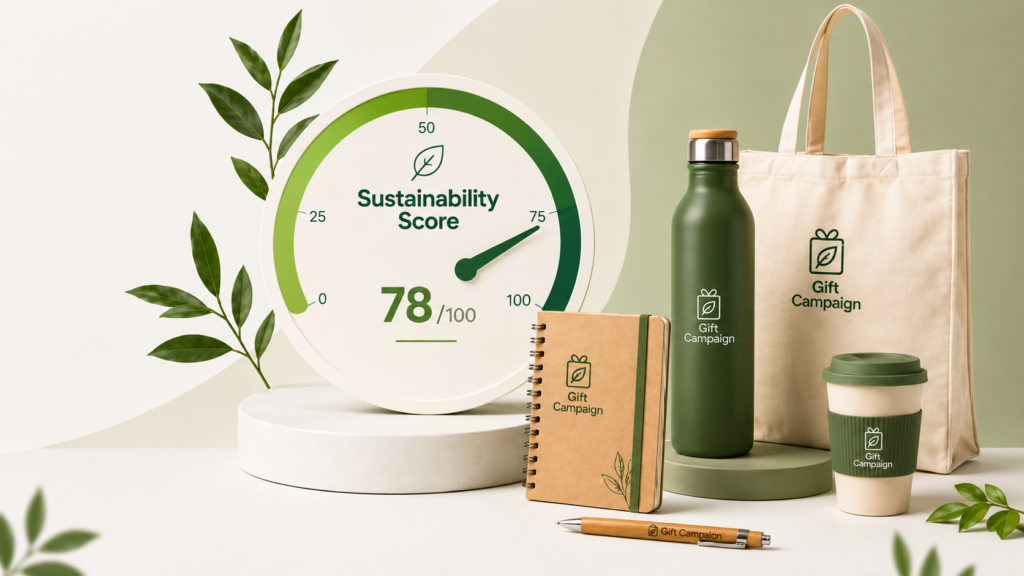
Sustainability has become an increasingly important criterion for businesses. It no longer only influences their internal processes, but also their choice of suppliers, the organisation of events, their communications activities and, of course, the gifts they give to employees, customers and business partners.
However, choosing a responsible promotional product is not always straightforward. Two products may both be presented as eco-friendly and yet have significant differences in terms of materials, certifications, packaging, place of manufacture or supply chain conditions.
To make this comparison easier, at Gift Campaign we have developed our own Sustainability Index, a methodology that analyses the environmental and social attributes of products and converts them into an easy-to-understand score. The aim is to help businesses make more informed and transparent purchasing decisions that are aligned with their corporate social responsibility commitments.
· Why have we created our own index?
The promotional gifts market offers an increasing range of products made from recycled, natural, reused or certified materials. This is a positive development, but it has also led to a proliferation of terms such as “eco”, “green” and “sustainable” that do not always provide a clear picture of a product’s actual impact.
For example, knowing that a bottle is made from stainless steel or that a bag contains recycled cotton is relevant information, but it does not, on its own, explain the full story behind the product. It is also useful to know what percentage of the material is recycled, whether there is independent certification, how the product is packaged, where it was manufactured or whether the supplier undergoes social audits.
Our Sustainability Index was created to bring all this information together, organise it and present it in a straightforward way.
With this tool, we aim to:
- Make it easier to compare different products in our catalogue.
- Give greater visibility to certifications and documented evidence.
- Reduce the risk of using vague or inaccurate environmental claims.
- Help businesses apply sustainable criteria to their purchasing decisions.
- Promote greater transparency throughout the supply chain.
It is not simply a matter of identifying products that contain a material considered environmentally friendly. The index assesses each product from a broader perspective, taking into account both its environmental attributes and the social and corporate information available about its manufacturing and suppliers.
· A score based on six dimensions
Each product assessed can achieve a maximum score of 100 points. The score is calculated by analysing six dimensions, each with a different weighting within the methodology.
1. Material: up to 40 points
Material carries the greatest weighting, as it has a significant influence on a product’s overall impact and its potential for reuse or recycling.
Particular consideration is given to reused, recycled and renewable materials, as well as those with a high recycling potential. We also take into account whether the material with sustainable attributes is the main component of the product or only appears in a secondary part.
Examples of the materials assessed include recycled polyester, recycled aluminium, recycled cotton, bamboo, cork, wood, glass, stainless steel and textiles made from production waste.
2. Certifications: up to 20 points
Certifications help substantiate certain characteristics through checks or verification carried out by independent organisations.
The index considers standards relating to recycled content, traceability, forest management, organic textiles and social conditions. These include GRS, RCS, FSC, PEFC, GOTS, Fairtrade, OCS and OEKO-TEX, among others.
Not all certifications have the same scope. Some verify the origin of a raw material, others monitor the chain of custody, while some combine environmental and social criteria. As a result, the score awarded depends on the level of verification and the areas covered.
3. ESG Supplier: up to 15 points
A product’s sustainability does not depend solely on its composition. How the company that manufactures or supplies it operates is also important.
This section assesses external corporate sustainability evaluations, environmental management systems and social audits relating to working conditions and workers’ rights.
The index takes into account evidence such as EcoVadis, B Corp, SA8000, amfori BSCI and SMETA. When a supplier has several assessments, the one providing the most relevant information or the highest score within our methodology is taken into consideration.
4. Packaging: up to 10 points
Packaging can generate a significant amount of waste, particularly for large orders.
For this reason, products are given a higher score when they are supplied without individual packaging, use recyclable paper or cardboard, incorporate compostable or biodegradable materials, or several units are grouped together in the same packaging.
Formats that reduce the use of plastic and the amount of material required per unit receive a higher score.
5. Origin: up to 10 points
The place of manufacture also forms part of the assessment.

The methodology combines proximity to the destination market with the regulatory and social context of the producing country. Manufacturing in Europe or closer to the destination market can reduce transport distances and facilitate greater control over the supply chain.
A lack of information about the country of manufacture is also reflected in the score, as transparency is one of the fundamental principles of the index.
6. Advanced Data: up to 5 points
Finally, additional points are awarded when verifiable evidence is available that provides greater insight into a product’s impact or traceability.
This may include data on carbon footprint, recognised social audits or traceability systems such as AWARE or Waste2Wear.
· The importance of working with verifiable information
One of the key features of the Sustainability Index is that it is not based solely on commercial descriptions.
To calculate the score, we use technical specifications, information on composition and packaging, country of manufacture, certifications, audits and documentation provided by suppliers. Where available, we also consider data on carbon footprint, traceability and verifiable social initiatives.
This means that a lack of information can lower a product’s score. This does not necessarily mean that the product performs poorly; rather, there is insufficient evidence to award it certain points.
This approach is important because it encourages greater transparency. The more verified information a manufacturer or supplier provides, the more comprehensive the assessment can be.
· What does the score mean?
The Sustainability Index allows products within the Gift Campaign catalogue to be compared. A high score indicates that a product has more sustainable attributes and that these attributes are better documented.
However, the score should not be interpreted as an absolute measurement of the product’s overall environmental footprint. The index does not replace a full Life Cycle Assessment (LCA), which would require an in-depth analysis of factors such as energy and water consumption, emissions, transport, use and end-of-life for each individual product.
The score should instead be understood as a comparison and decision-making tool. Its purpose is to show, in a clear and consistent way, what sustainability-related information is available for each product.
Scores may also be updated when we receive new certifications, changes to packaging, manufacturing data, supplier assessments or additional information relating to traceability and carbon footprint.
· An index you can consult while shopping
The score and its breakdown are included on Gift Campaign product pages, allowing businesses to consult the information while comparing different options.
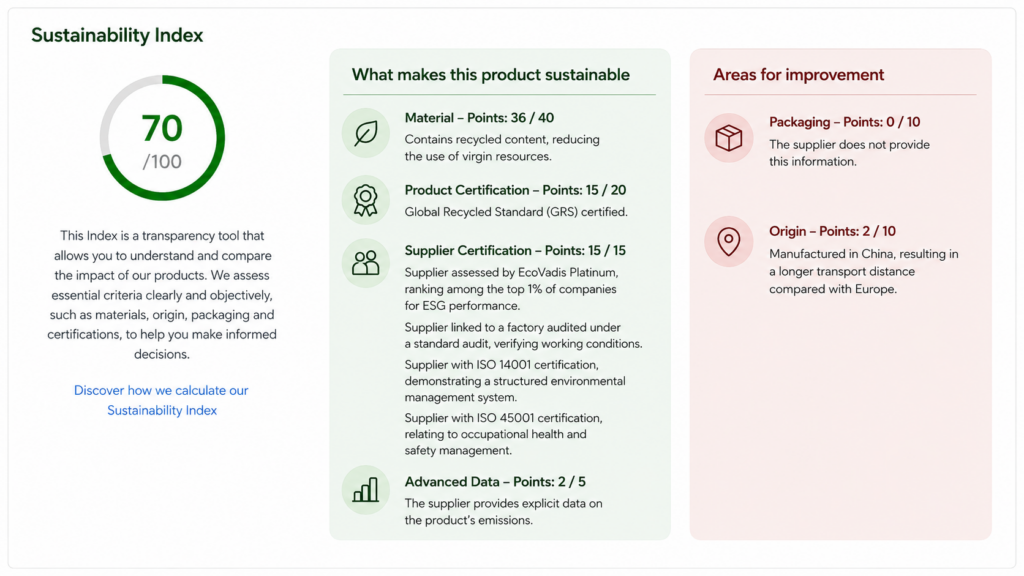
In this way, an organisation can focus on the overall score or prioritise a specific dimension depending on its objectives.
For example:
- A company focused on the circular economy may place greater importance on the materials category.
- An organisation looking to reduce its logistical impact may prioritise products manufactured in Europe or nearby regions.
- A company with specific social requirements may pay particular attention to the supplier’s certifications and ESG assessments.
- A campaign aimed at reducing waste may place greater value on products supplied without individual packaging.
In this way, sustainability moves beyond being a generic label and becomes a practical criterion that can be incorporated into the purchasing process.
· Our commitment goes beyond the catalogue
The creation of this index is part of Gift Campaign’s broader commitment to sustainability, ethical business practices and continuous improvement.
The company has a Sustainability Report, which outlines its initiatives and alignment with the Sustainable Development Goals. Its responsible management has also been recognised with an EcoVadis Silver Medal, an assessment that examines areas such as the environment, labour and human rights, ethics and sustainable procurement.
Gift Campaign also has an Ethical Code, which sets out the principles that should guide the conduct of the company and its employees. These include integrity, equal opportunities, respect for people, transparency and responsible relationships with customers, partners and suppliers.
These initiatives are complemented by the ongoing update of the catalogue with lower-impact products, collaboration with suppliers to improve the information available, and various internal measures relating to recycling, sustainable mobility and waste reduction.
· A new way to choose promotional gifts
We recognise that no product has zero impact. That is why our aim is not to simplify sustainability through a label or present an option as perfect when it is not.
We want to provide clear, accessible information, show the evidence available and make it easier for each company to choose according to its own priorities. If your company wants to start applying these criteria to its upcoming campaigns, a good place to start is by exploring our selection of eco-friendly promotional products, where you will find reusable and recycled products, as well as products made from lower-impact materials. This new measurement will also help you compare each product with greater context and choose the option that best fits your objectives.
The Gift Campaign Sustainability Index therefore represents another step towards a more transparent promotional products industry. It is a tool designed to turn technical data, certifications and social criteria into useful information for those who want their corporate gifts to represent not only their brand, but also their values.