

In a market where thousands of companies are competing for the attention of the same customers, partners and collaborators, standing out is no longer an advantage: it is a necessity. However, most corporate branding strategies continue to follow the same patterns. The same tone, the same corporate colours on the same products, the same old pen engraved with the company logo.
Creativity applied to branding is not about doing things in a flashy way. It is about doing things in a memorable way. And there is a huge difference between the two.
· Market Saturation in the Corporate World and Its Consequences
Corporate clients are constantly exposed to brand stimuli: emails, phone calls, newsletters and corporate gifts at Christmas, among many others. Companies are continually investing in digital presence, events, advertising and loyalty campaigns which, through sheer repetition, have lost much of their impact.
The result? Growing indifference. When everyone is doing the same thing, nothing stands out.
The saturation of stimuli is now everywhere — on mobile phones, in the street, at the point of sale and across social media — and in this environment, differentiation has ceased to be a desire and has become a necessity. Several studies on consumer behaviour, including analyses by McKinsey & Company, highlight how the growing saturation of both digital and physical channels has made attention an increasingly scarce resource. In this context, a brand’s ability to differentiate itself and build trust has become a decisive factor in standing out and remaining memorable over time.
This figure is significant: when branding experts themselves overwhelmingly believe that branding is becoming increasingly critical, ignoring it comes at a very high cost — weaker brand recall, colder business relationships and a perception of interchangeability that makes customer loyalty more difficult to achieve. If your company can be replaced by another without the client noticing much difference, then something is wrong with your brand strategy.

· What Creativity Applied to Branding Really Means
Originality is often confused with extravagance. However, in the context of branding, being creative does not mean breaking the mould or adopting a loud, attention-seeking identity. It means finding genuine ways to express your company’s values in a way that truly connects with your audience.
In practical terms, creativity applied to branding is understood as:
- Purpose-driven consistency: Every element of communication reinforces who you are and what you offer.
- Sustained distinctiveness: You do not just surprise once, but build a recognisable identity over the long term.
- Emotion before information: You prioritise emotional impact over the mere transmission of corporate data.
When applied well, creativity is not a branding expense. It is an investment in positioning.
· Competitive Advantages of Embracing Originality
Companies that choose to differentiate themselves in an authentic way gain concrete benefits, not just aesthetic ones.
Brand Memorability
People remember what surprises them or triggers a positive emotional response. In this sense, it is worth noting that purchasing decisions are influenced by branding, which makes brand identity a determining factor in the commercial process rather than a decorative element.
Greater Effectiveness in Marketing Activities
A brand with a clear identity not only has more impact, but also performs better. According to data from Forbes, companies with a coherent and well-defined brand identity can increase their revenue by up to 23%. In other words, investing in branding does not only build image — it directly improves the results of every commercial action.
Customer Loyalty and Emotional Connection
Corporate client loyalty is not built solely on price and quality. It is built on the perception that the relationship has value beyond the transactional. When a company shows that it understands its customer and makes an effort to engage them in a meaningful way, it creates stronger and longer-lasting bonds.
Differentiation from Competitors
In sectors where products or services are very similar across different suppliers, the brand experience becomes the key differentiating factor. Creative companies do not compete only on price; they compete on perceived value, which gives them a far more comfortable negotiating position.
· Original Corporate Gifts as an Extension of Branding
If there is one underrated branding activity in the business world, it is the corporate gift. For decades, it has been treated as a formality: something that must be done at certain times of the year or on specific occasions, chosen more hastily than thoughtfully and with the aim of keeping costs to a minimum.
However, the corporate gift is, in reality, one of the most powerful touchpoints a company has with its environment. It is physical, personal, and received in a context that differs from everyday business interactions.
According to a study by the Promotional Products Association International (PPAI), 88% of respondents were able to recall the company that gave them a promotional gift. In addition, 59% reported having a more favourable opinion of the brand that provided the gift. These figures are not achieved through campaigns carried out exclusively in digital media, television, or print, as those channels lack the physical and tangible element that remains in the recipient’s environment, generating repeated and sustained exposure over time.
When a client, supplier, or collaborator receives an unexpected gift, something happens that no thank-you email can replicate: a positive experience directly associated with your brand.
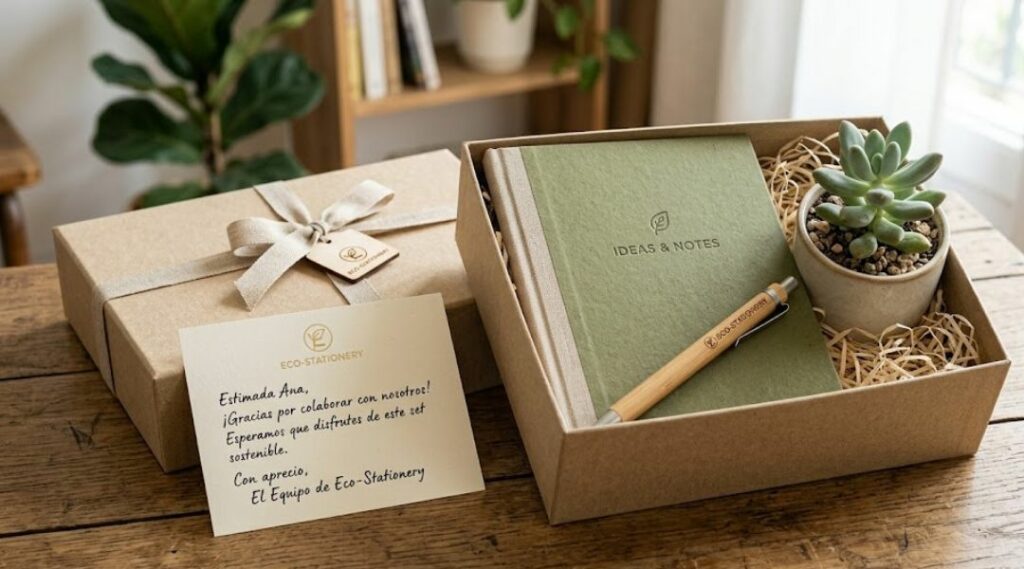
However, for such a gift to have a genuinely positive impact, it is essential that it is useful, addressing real needs; sustainable, adding ecological value to your brand; or original, setting itself apart from the merchandising offered by any other company.
But what actually makes a gift truly original?
Originality in corporate gifts is linked to attention to detail and the ability to surprise within a coherent context, with your brand identity at its core. An original gift is:
- Unexpected in its form or presentation.
- Relevant to the person receiving it.
- Consistent with the values you want to communicate as a company.
- Memorable, something the recipient will not throw away after a couple of days.
In other words, the difference between a generic gift and an original one is exactly the same as the difference between a company that goes unnoticed and one that builds its brand through every interaction.
· How to Choose Original Corporate Gifts Without Losing Brand Consistency
One of the most common mistakes when pursuing originality is losing sight of corporate identity. A gift can be eye-catching and, at the same time, say absolutely nothing about who you are. That is not branding — it is simply another form of noise.
For a gift to work as a branding tool, it is worth applying the following criteria:
- Start with your values, not the catalogue. The starting point should not be “Which gift is trending?” but rather “What does this gift say about us?”. A company committed to sustainability, for example, will find far greater consistency in eco-friendly products than in generic tech items.
- Think about the recipient, not just your brand. Personalisation is not simply about adding a logo. It means choosing something that the person or company will genuinely value. The more appropriate the gift, the more strongly it communicates the idea that you understand and care about the client.
- Value the presentation as much as the product itself. The packaging, the accompanying message and the timing of delivery are all part of the gift. A carefully considered presentation significantly increases the perceived impact.
- Choose something distinctive while remaining relevant. There is no need to be extravagant; there is a need to be different. And in a market where most companies give the same things, that distinction is far more valuable than it may seem.
If you are looking for inspiration beyond the usual catalogue, our original corporate gifts offers options designed for brands that want to leave a lasting impression without compromising brand consistency.
· Conclusion: Creativity Is Not a Luxury, but a Strategic Decision
Companies that invest in creativity do not do so because they have larger budgets. They do it because they understand that, in a saturated market, what is not remembered simply does not exist.
Research from McKinsey & Company on consumer behaviour highlights that in increasingly saturated and attention-driven markets, differentiation and trust are key drivers of brand success. In this context, the human side of a brand — the ability to empathise, listen and act consistently — becomes central to building long-term trust, loyalty and memorability.
Ultimately, embracing originality means choosing to be relevant. And in the business world, relevance brings a very tangible return: stronger relationships, more loyal clients and a brand that does not need to shout in order to be heard.