
Sustainability is gaining ground at a rapid pace, to the point where it has become a decisive factor for consumers when choosing a product or brand.
According to an Amazon study, 66% of UK shoppers prefer to buy sustainable products, although users find it difficult to identify them. This is where the real question lies: what exactly does it mean for an item to be sustainable? We have accepted that cardboard is “good” and plastic is “bad,” but the reality is that true sustainability goes much further.
Throughout this article, we will examine the case of BIC, a leader in its sector in terms of ecology, and explore why a plastic pen can, in some cases, be far more responsible than one made from natural materials.
To classify a product as sustainable, it is necessary to have a 360° view of it and to analyse its entire life cycle from start to finish. This includes everything from where the raw materials are sourced to how many kilometres the product travels before being recycled.
Factor 1: The Product Life Cycle
When it comes to manufacturing, BIC always seeks material efficiency, prioritising designs that use only what is strictly necessary. The aim is not to eliminate plastic, but to optimise it through eco-design to reduce the weight of items. Thanks to this approach of reengineering products and packaging, they have managed to save 870 tonnes of raw materials in a single year.
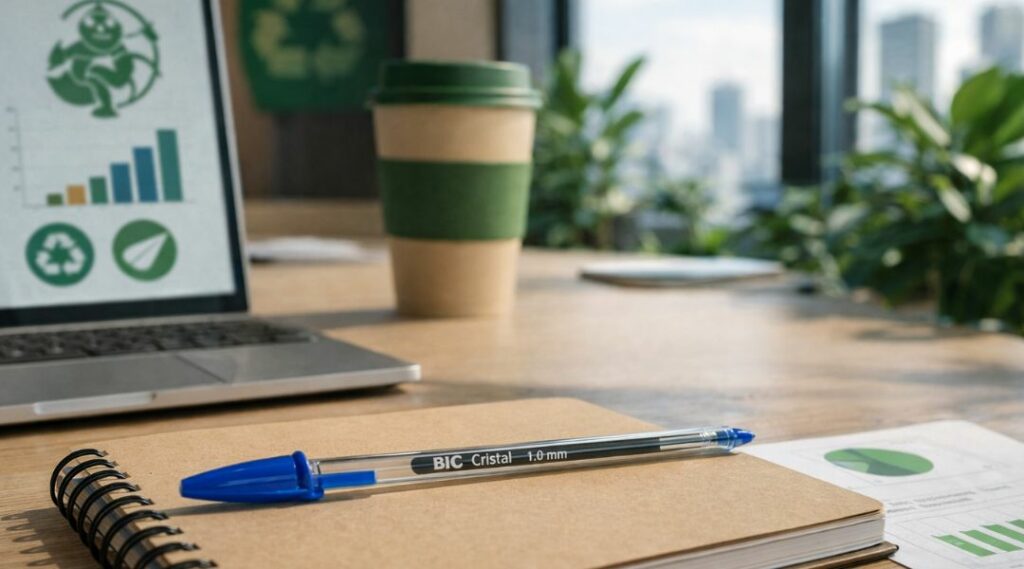
Furthermore, the most environmentally friendly gift is the one that isn’t thrown away. A pen that stops writing after two days and has to be constantly replaced serves no purpose. True sustainability lies in efficiency. For this reason, it is important to prioritise product quality, as in the case of the BIC Cristal Pen, designed to write up to 3 km.
Factor 2: Proximity
BIC integrates environmental awareness throughout its entire value chain, recognising that one of the greatest threats to the planet is transoceanic transport. For this reason, they prioritise regional manufacturing plants in Europe, located in places such as Tarragona (Spain) and Samer (France).
This regional “hub” manufacturing strategy brings products closer to local markets. In fact, thanks to logistical optimisation and a drastic reduction in air freight usage, they have managed to cut transport emissions by 6% compared to the previous year.
Factor 3: Certifications and Transparency
On many occasions, companies engage in greenwashing– a marketing strategy aimed at appearing eco-responsible when, in reality, they are not. To show that BIC is a genuinely committed brand, their work is supported by external certifications.
- Through product certifications, they hold the NF Environment label for 17 of the company’s product lines.
- A sustainable company must audit its own suppliers. Currently, 95% of BIC’s strategic suppliers are assessed by EcoVadis, achieving an average score of 60/100, well above the industry average.
Factor 4: From Disposable to Circular
The transition towards a circular economy is the ultimate step in transforming everyday objects into low-impact solutions. This model focuses not only on end-of-life recycling but also on how innovation in materials and the use of clean energy during production can close the loop on responsible consumption.
BIC received a B rating from the Carbon Disclosure Project (CDP), a global authority on carbon emissions, highlighting its commitment to reducing climate impact and supporting the circular economy.
- A product is more sustainable if its factory uses renewable energy sources. Currently, BIC operates on 92% renewable electricity globally.
- It is already possible to find pens with inks containing up to 93% natural ingredients and markers with 81% natural content in BIC’s catalogue.
- They promote reuse with products such as the new BIC® EZ Load lighter, which, being refillable, can produce up to 15,000 flames—a key step towards zero waste.
- They also use materials with a “past life.” Not all plastics are the same. In facilities such as the Samer (France) factory, 43% of the plastic used is already recycled.
The BIC case shows that when a plastic pen is locally manufactured, designed to last for years, and produced using renewable energy, it becomes a far more responsible and coherent choice than any low-durability or uncertain-sourced “natural” alternative.
For this reason, if you are looking for a quality and reliable option for your brand, we invite you to explore our range of customised pens for businesses.