
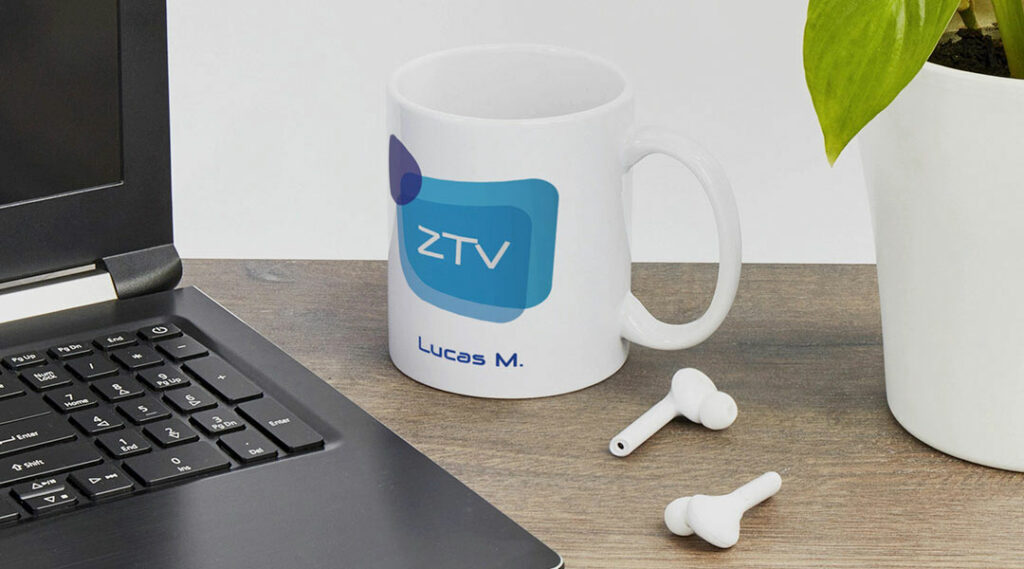
How can a brand stand out when the digital environment is saturated with marketing messages? Today we face a paradox: companies have never communicated so much, yet their relevance has never been so volatile. While an email can be deleted in milliseconds, a branded mug sitting on a desk may be used more than 300 times a year.
This phenomenon marks the strategic return of Touch Marketing (tactile marketing) – a critical ally against the immaterial nature of the digital ecosystem.
The Psychology of Ownership: From Prospect to Owner

In the field of neuromarketing and cognitive science, the evidence is clear: touch activates an immediate sense of ownership. As soon as an individual holds an object, the brain triggers mechanisms associated with possession. This reflects a cognitive bias through which we tend to assign greater value to things we own.
The Endowment Effect
This phenomenon has been widely documented in behavioral psychology as the endowment effect, highlighted by researchers such as Richard Thaler and Daniel Kahneman.
Even Aristotle, in Nicomachean Ethics, observed:
“Most things are valued differently by those who possess them than by those who wish to obtain them; what belongs to us always seems very valuable.”
Scientific Evidence: A study by J. R. P. Wolf, Hal R. Arkes, and Waleed A. Muhanna (2008) demonstrated that holding a mug for just 30 seconds significantly increases the price a person is willing to pay for it. Participants who physically touched the object offered higher prices than those who only observed it.
Source: Wolf, J. R. P., Arkes, H. R., & Muhanna, W. A. (2008). Is Overvalued Possession Product-Specific? The Effects of High Physical Intensity and Virtual Touch on the Endowment Effect.
The experiment conducted by Knetsch (1989) revealed that the value of a good increases the moment it enters our possession. In the study, one group of participants received a mug while another received chocolate. Despite both items having identical market value, most participants refused to trade, demonstrating a clear preference to keep the item they already owned.
Source: Knetsch, J. L. (1989). The Endowment Effect and Evidence of Nonreversible Indifference Curves. The American Economic Review.
Self-Extension: When a Branded Object Enters the Home or Office
In the world of promotional products, owning high-quality branded items increases the perceived value of the object and, by extension, the brand associated with it. Once the item is taken home, it becomes familiar and enters the intimacy of everyday life. What begins as a simple promotional gift can evolve into a relationship of proximity with the brand.
In psychology, this phenomenon is often described through the concept of self-extension. A physical object that we regularly handle is no longer perceived as just an external “thing.” Over time, the brain begins to integrate it as part of our personal territory. Because of its emotional charge—and unlike sight or hearing—touch is a proximal sense: it requires breaking the “safety distance.” In marketing terms, this interaction can transform a “prospect” into an “owner”.
Loss Aversion: Why It’s So Hard to Throw Away an Object (Unlike an Email)
The most powerful aspect of this phenomenon is undoubtedly loss aversion, a concept strongly associated with the work of Daniel Kahneman and Amos Tversky. Once an object is in the customer’s hands, parting with it is no longer perceived as simply “not buying”—it becomes “losing something”. And the brain strongly dislikes losses.
Did you know? This is precisely why car dealerships insist so strongly on test drives. It’s not really about testing the brakes—it’s about getting your hands on the steering wheel so that your brain starts thinking: “This is my car.”
Retinal Memory vs. Haptic Memory: Why the Brain Better Retains What It Touches
Digital communication primarily engages visual memory – fast and efficient, but structurally fragile. In contrast, haptic memory, which is linked to touch, is one of the most persistent forms of memory in the human brain.
A physical object stimulates multiple senses simultaneously. These are the four pillars of a physical promotional object:
- Weight (a symbol of seriousness and solidity)
- Texture (a vector of emotion)
- Temperature
- Ergonomics
The result is a much deeper mnemonic imprint. Where a digital advertisement disappears within the endless flow of information, a physical object remains. It reminds us of itself again and again, without requiring any cognitive effort. That is the strength of object-based communication.
Digital channels are highly effective for reach, but they suffer from cognitive volatility. An email can be deleted with a single click; a physical object imposes its presence.
| Characteristics | Digital Advertising | Promotional Object |
| Duration | Ephemeral (seconds) | Durable (months/years) |
| Recall | Low (visual overload) | Strong (haptic memory) |
Why Your Mug Is More Profitable Than Your Google Ads

In any office, two realities coexist: the screen flooded with emails and notifications, and a few physical objects on the desk. Today, for a marketing manager, the challenge is no longer just being seen, but remaining memorable. This means not limiting efforts to digital channels, but considering the long-term impact of a message. Could the ROI of promotional items actually outperform digital advertising?
The Click Illusion: When the Budget Stops, the Brand Vanishes
Digital marketing relies on cost per thousand impressions (CPM): you pay to appear briefly in an already overloaded flow of content. You buy 10,000 impressions—but how many of those actually cross the threshold of awareness? Numbers can look impressive on paper, but much of the messaging goes unseen and unremembered, blocked by ad blockers or simply ignored by habitual banner-skipping. As soon as the budget stops, visibility disappears instantly, leaving no lasting brand memory.
The Object: An Asset That Works (for Free) for You
Unlike digital ads, a promotional object is a durable investment. You’re no longer renting attention—you’re being physically present in the customer’s home or office. A useful object, like an office accessory, is purchased once, but is used daily. Every use reinforces the brand, sometimes hundreds of times per year. And the longer the object lasts, the more “free” each brand impression becomes. Over time, it becomes one of the few marketing channels whose effectiveness does not expire.
Conclusion: The Real World Makes the Difference Compared to Digital
This is not about pitting physical against digital. It’s about recognising that, in an immaterial world, real objects become a powerful differentiator. By engaging multiple senses simultaneously, a physical object creates a much deeper and longer-lasting mnemonic imprint. To stand out amid the numerical noise of digital channels, the most modern strategy may be returning to humanity’s oldest sense: touch. Touch Marketing is therefore not a step backward. It is a solution for brands seeking to anchor themselves durably in the minds of their customers. Object-based communication is no longer just a “gift” – it is a strategic asset, securing both your authority and your lasting presence in the market.